
Value Stream Leadership and Tiered Meetings Enables Production Support & Continuous Improvement
A complex production process requires a mixture of leadership, governance and daily management. This article explores a tiered meetings structure that can effectively enable this. Key elements such as empowerment, escalation paths, accountability and responsibility form the foundation of this approach. We begin with a diagram which illustrates a typical governance process:
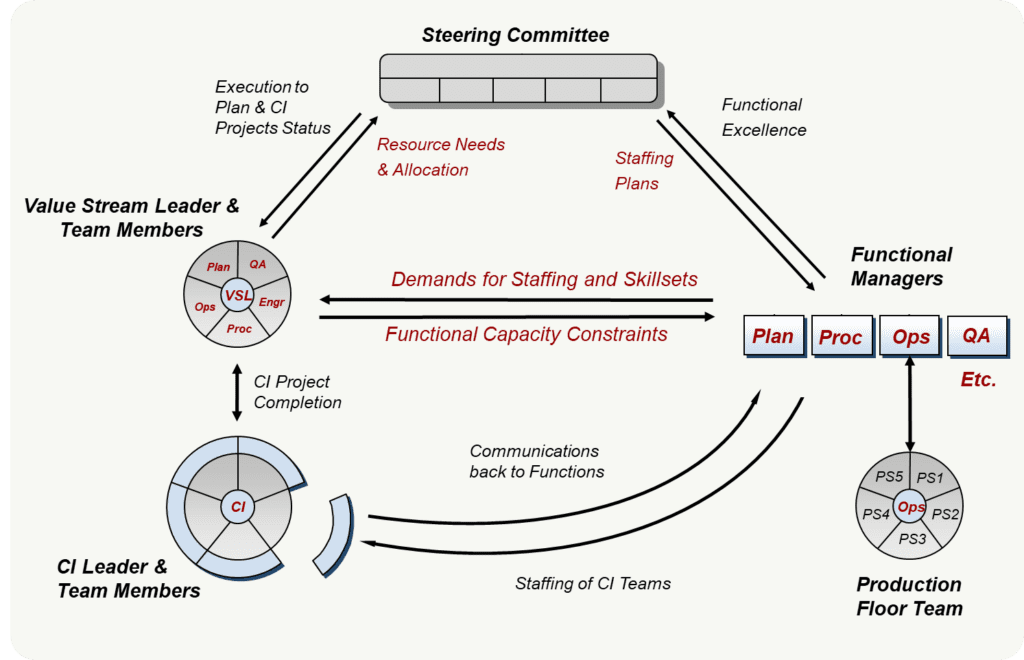
While this illustration might look complicated, one can see both a (horizontal) cross-functional view, as well as an (vertical) escalation path. A central figure in this cross-functional escalation process is the operations Value Stream Leader (VSL). The VSL is the tiered meeting process owner, responsible for effective information flow within and between the tiered meetings as well as between functions. Let’s use this governance structure and overlay tiered meetings as follows:
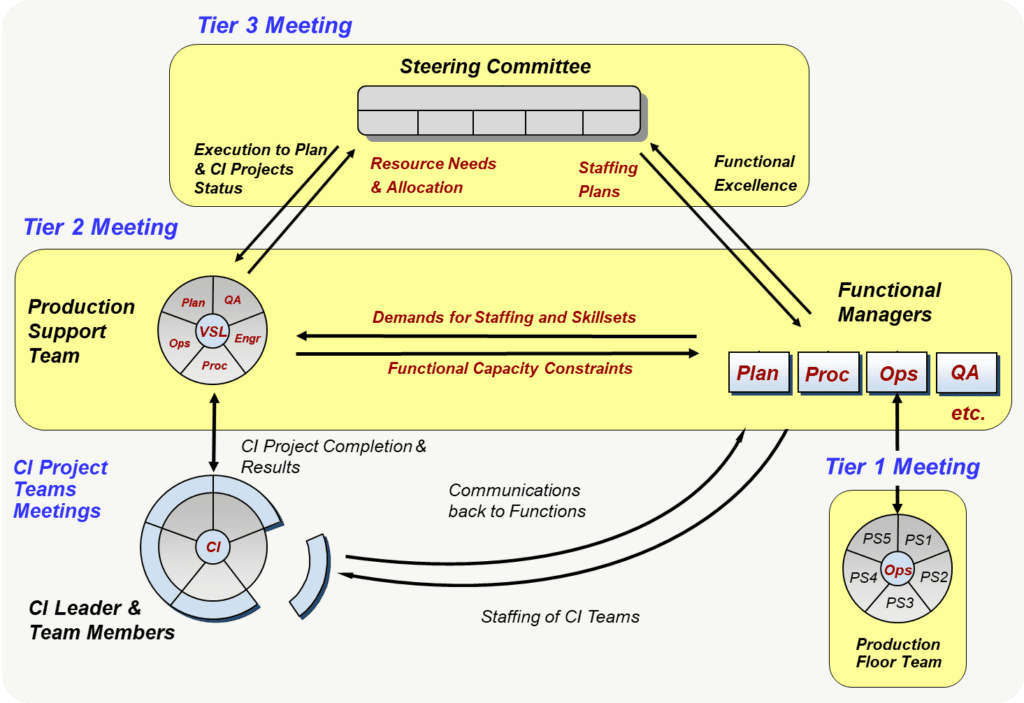
A description of each of meetings is provided as follows:
Production Floor Team Meeting (Tier 1): a daily stand-up held by production supervisors and the operations manager. Its primary purpose is to set daily (or shift) production targets, review performance, and quickly identify and resolve issues at the source. A visual performance board can be used to categorize issues/actions into two groups (1) issues that can be resolved by the production floor team or (2) issues that require support by specialized functions. Unresolved or complex issues are collected by the operations manager and escalated to the Production Support Team (Tier2). If multiple cells or work areas are involved, a separate Tier1 report-out may be conducted. Of course, the VSL and/or any support function can attend the Tier1 report-out as needed to gain firsthand insight into specific problems, bottlenecks, or constraints.
Production Support Team Meeting (Tier 2): a daily cross-functional team meeting facilitated by the Value Stream Leader (VSL) who serves as the overall owner of the tiered meeting process. Leveraging a comprehensive view across all functions, the VSL collects actions and resource needs from the functional managers to optimize the value stream(s). Functional managers are accountable for identifying and resolving the issue(s) and/or accountable for provide the necessary skillsets and capacity. Failure to do so will result in persistent capacity constraints and/or a sub-optimized value stream.
The VSL is responsible for determining and maintaining value stream KPIs that represent total shop-floor output, lead times and other value-stream oriented KPIs. During the meeting, the VSL collects unresolved issues and actions, facilitates discussion, documents action item status and priorities and identifies improvement projects. Reasons for any shortfall in shop-floor output should be determined at these meetings by functional managers who represent their respective functions (planning, procurement, quality, engineering, etc.). Unresolved actions, systemic issues or skillset gaps, are documented and mutually agreed-upon by functional managers for escalation to the Operations Steering Committee (Tier3). An electronic dashboard with KPIs and prioritization matrices can be used to facilitate data-driven discussions and enable the escalation path to the Operations Steering Committee (Tier3) meeting.
Note that the Operations VSL reports to the site General Manager and may have a Continuous Improvement (CI) leader and additional resources. This structure provides dedicated resources for operational monitoring & execution, value stream optimization, and effective management of the tiered meeting process. This also ensures sponsorship and resourcing for continuous improvement projects with team members provided by functional managers (see CI Project Teams in the above graphic).
Production Steering Committee Meeting (Tier 3): a steering committee typically serves as the highest level of governance in an organization or major initiative. It provides strategic oversight, ensures alignment with business objectives, and makes key decisions that balance competing priorities.
In the context of production operations, the Production Steering Committee (Tier 3) assesses execution to production plan, reviews the status and progress of CI initiatives, monitors functional excellence and approves staffing plans & resource allocation. Recall some fundamental constraints are cost/resources, schedule and scope. The Committee operates within those constraints. Its core responsibility is to make critical trade-off decisions: determining what the business will and will not do (scope), allocating additional resources (and accepting the associated costs), or extending timelines to allow for issue resolution.
Cost/scope/schedule are the primary levers; each can be adjusted through deliberate prioritization of the highest-impact actions, critical skillset needs and most urgent issues requiring resolution.
The VSL facilitates this weekly Tier3 Production Steering Committee meeting. In this forum, the VSL presents current production KPIs and prioritization matrices to a committee of functional managers and the chairperson. The steering committee chairperson is ultimately accountable for overall production performance through effective prioritization and timely decision-making. The VSL is responsible for facilitating and monitoring the meeting outcomes. All decisions and actions are clearly documented and provided to the responsible functional managers.
Let’s summarize some key features of this tiered meeting process :
- Improved Labeling of Meeting Purpose: the intent of meetings gets lost when simply referring to meetings as Tier1, 2 and 3. Labeling the meetings as Production Floor, Production Support, Production Steering Committee generally improves mutual understanding of the purpose of each of the meetings.
- Early Visibility: production floor teams problems/issues/opportunities are surfaced quickly during the daily Production Floor Team Meetings(Tier1) enabling rapid response and alleviating potential production bottlenecks.
- Clear Escalation Path: Issues that cannot be resolved at the Production Floor Teams Meeting (Tier1) are systemically escalated to the Production Support Team Meeting (Tier2), enabling timely cross-functional support while keeping decisions at the lowest effective level.
- Broad Oversight: the VSL maintains visibility across all value streams, all operational support functions and all three tier levels. The VSL owns the tiered meeting process with a strong focus on effective information flow, tiered meeting effectiveness, action item management and prioritization.
- Continuous Improvement Enablement: the VSL is empowered to identify continuous improvement projects and secure the necessary sponsorship and functional team members necessary.
- Effective Tools and KPIs: and electronic dashboard and prioritization matrices can be easily updated and continuously improved. The tools and KPIs can serve as powerful facilitation aides for both the Production Support Team Meeting (Tier2) and the Production Steering Committee (Tier3).
- Respectful Escalation: Escalation primarily focuses on securing additional resources or skillsets while supporting — rather than second-guessing — existing functional expertise. Issues are first addressed through the functions, with escalation to the Steering Committee occurring only with the functional manager’s concurrence.
- Clear Accountability: Responsibility for closing actions remains with the appropriate functions, reinforcing functional excellence.
- Focus on Functional Expertise: Functional managers concentrate on providing the right skillsets and experience within their discipline.
- Strong Process Ownership: the Operations Value Stream Leader is accountable for effectively facilitating meetings, escalating issues appropriately, and driving project and program management.
- Data-Driven Culture and Better Decision-Making: Visual performance boards, KPIs, and prioritization tools promote fact-based discussions, trend analysis, and proactive rather than reactive management.
- Improved Alignment and Reduced Silos: The horizontal cross-functional view combined with vertical escalation creates strong alignment from the shop floor to senior leadership, breaking down departmental barriers and fostering collaboration.