
An Operational Strategy Using a Systems Engineering Approach
In our previous article, we emphasized establishing a strategy before claiming that an operating system exists when it still had to be built.
This article will propose a strategy using a systems engineering approach: we will consider “needs”, the “what” and “how” our system will be built. Starting with the “needs”, let’s consider what we want from our companies’ people, processes and products. These might be considered high-level requirements or principles:
- A culture of quality, teamwork and productivity (People)
- Standardized, recurring processes and metrics (Processes)
- Disciplined investment aligned with strategic priorities (Products, plus strategic process improvement initiatives)
Now we’ll ask WHAT the elements of our strategy are in order to meet those needs:
- Project sponsorship and governance
- Effective core team and tiered meetings
- Standardized work and operational metrics
- Functional excellence
- Supporting tools and methods
Our strategy is to use these enablers to move from the current state to an improved future state. They will give us a thorough and reliable operational process (or system). Note that both layers are mutually reinforcing.
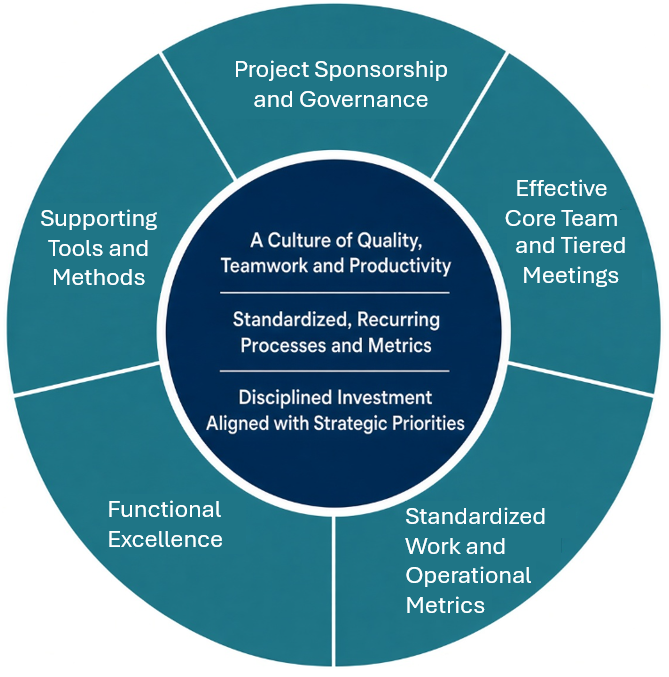
Let’s assume we have a process that’s not working well, and consider how we’ll get to improved future state system. Keywords from our strategy are highlighted as follows:
How will this all work? In order to establish the system we’ll need a project to get to an improved future state. A cross-functional core team of process participants and subject matter experts will be needed…and project sponsors will need to support the team by providing and empowering those resources. A core team leader is assigned, and effective core team meetings will leverage supporting tools and methods. (note that meeting effectiveness is included as a method). Project management fundamentals, value stream mapping and/or a kaizen workshop will be leveraged by lean six sigma practitioners who partner with the core team leader and co-facilitate. Actions are identified to achieve the desired future state. The team closes-out as many actions as possible during the workshop.
Functional excellence is expected from each representative function (or process participant). This is also the expectation of the project sponsors and the purpose of the project governance process: to ensure project progress and functional excellence. The project status is presented at key gates or milestones such as between Define-Measure, Analyze-Improve, Control-Close. The project outcome should include standardized operational metrics, standard work and (potentially) tiered meetings to monitor and execute the recurring operational process. We now have an completed element of the operating system.
One can see the proposed strategy and the scenario illustrated includes all the ingredients to successfully achieve an improved future state.