
Practical Use of The Supply Chain Operations Reference Digital Standard (SCOR DS)
The Supply Chain Operations Reference Digital Standard (SCOR DS) is a model that provides methodology, diagnostic and benchmarking tools that help organizations make dramatic and rapid improvements in supply chain and operational processes.
The SCOR Digital Standard (SCOR DS) is a part of the ASCM body of knowledge used to foster the advancement of end-to-end supply chain management. The SCOR model was first established in 1996 and has undergone several improvements since then to adapt to changes in business practices. The SCOR Digital Standard is a valuable on-line database that can be found here at SCOR DS.
The SCOR processes are provided as follows:
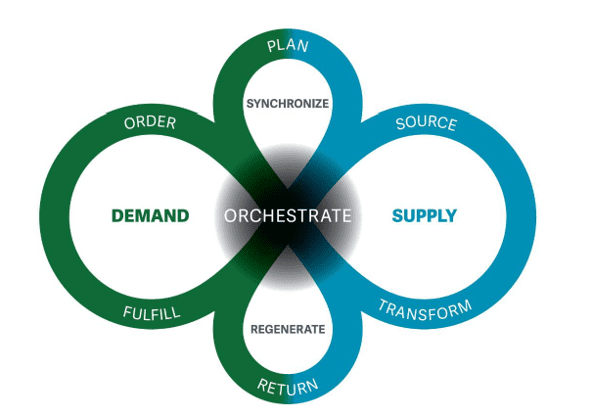
SCOR recognizes six major level-1 processes — Plan, Order, Source, Transform, Fulfill, and Return. The above graphic can be reformatted into a value stream mapping format:
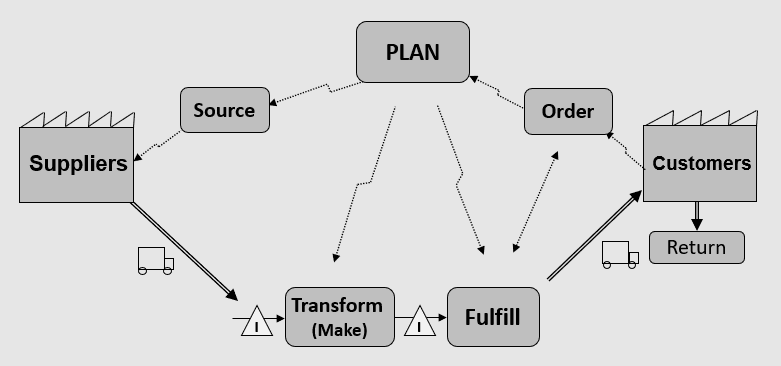
The model is quite comprehensive with hundreds of suggested metrics, parameters and definitions. While it can be somewhat challenging to apply in its entirety, it can be effectively used as a reference standard, or ‘dictionary’ of sorts.
Some strategic (Level 1) metrics are as follows:
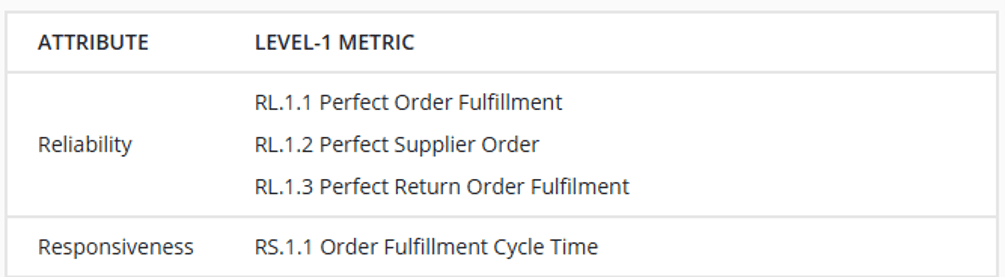
Using the reference standard, we labeled the process (order fulfillment) and also labeled the corresponding metrics. From a value stream perspective, we are interested in (for example) “Order Fulfillment Cycle Time”…defined in the SCOR model as the average actual cycle time consistently achieved to fulfill customer orders. For each individual order, this cycle time starts at the order receipt and ends with customer acceptance of the order.
This is broken down into its (Level 2) components as follows
- Order Cycle Time – time associated with order processes, which may include receiving, entering, and validating orders. A question to consider is: what is the customer’s understanding of when the “clock starts ticking” on order fulfillment?
- Source Cycle Time – to simplify this discussion, let’s assume we have materials on-hand to execute the transformation of the product.
- Transform Cycle Time – here is where we’ll rely on value stream mapping to understand components of cycle time, which might include the time to issue material, manufacture and test, release and package the finished product.
- Fulfill Cycle Time – may include time to load the vehicle and generate shipping documents, ship product cycle time plus receive and verify product by customer.
An important consideration here is timely payment from the customer once the clock starts ticking. ERP systems are often set-up with finance-oriented workstreams such as Order-to-Cash (O2C). The SCOR model therefore helps define the O2C and value stream parameters accordingly. Of course, there are also planning and orchestrating activities which enable this.
Three complementary tools: SCOR DS, value stream mapping and ERP systems can go a long way toward clear, mutual understanding of processes, metrics, metrics definitions and operational performance. Also consider the SCOR model provides three levels of metrics (strategic, tactical and operational) which might be reviewed according to your tiered meeting process. In summary, SCOR can help an organization establish an operational process monitoring hierarchy and speak a common, best practice language.